Want to know what’s eating your garden?

InvaderHello Again!

I was musing about what to write today, and as I traveled the web the thought occurred to me that I am always telling you how to take care of pest problems, but how about helping you identify what pest is causing the damage? Sometimes you may have spotted the pesky creature, but most of our customers seem to be guessing at what lurks in their gardens by night. So I found the following information published on the web by the UMass Amherst Center for Agriculture and I thought I would pass it on. (hyperlinks have been added by me – UMASS Amherst in no way endorses predatorpee.com)

Damage by Wildlife (Vertebrates)
Rabbits, Voles, Woodchucks, Deer, Chipmunks, Squirrels
All eat leaves or fruits of plants in vegetable gardens. Symptoms include:
Large parts of the plant are chewed off
Leaves are nibbled; stems cut
New growth is uniformly nibbled off
Plants are eaten to the ground
Fruits are damaged or removed
To help determine what vertebrate animal is causing the damage, sprinkle a layer of finely ground limestone around the damaged plants and look for animal tracks left in the powder the next day.
Rabbit damage can be identified by foliage that has been nipped off sharply, leaving no ragged edges. Seedlings might be grazed to the ground, and new growth uniformly nibbled off. Look for pea-sized droppings in the vicinity. Rabbits don’t travel far from their burrows or resting places. They feed at dusk, in the night and early morning. They favor tender beans, beets, broccoli, carrots, lettuce and peas. Deer damage can be easily confused with rabbit damage, but usually large parts of plants are chewed off and deer tracks will be evident in the soil.
Voles damage seedlings by chewing leaves and stems. Vole damage can be confused with cutworm damage because voles will move down a row of seedlings eating just the stems and toppling plants. Or, they might nibble only on the leaves. They feed mostly at night. Look for vole tunnels in grassy areas at the edges of the garden. Voles stay close to their tunnels and sometimes tunnel right into the garden. Problems are more likely to occur when vole populations are high.
Woodchucks tend to trample plants as they feed. They feed close to their burrows during the day, especially in mid-morning and late afternoon. Like rabbits, woodchucks seek shelter in weedy areas, stonewalls, brush piles or under porches and outbuildings. They like corn, beans and peas, but will browse on many tender garden vegetables.
Chipmunks and squirrels may develop a taste for fruits, such as tomatoes or strawberries, more often than the leaves of vegetables. Watch your garden in early morning and at dusk for rodent activity.”

Hope this is helpful. Once you identify the pest, make sure to get some all natural, organic 100% PredatorPee – accept no substitutes!

Happy Gardening!

Until I find some more words. . .

The PeeMan

Organic All Natural Pest Control for the Organic Grower

flowerfieldIt has been a few days since my last post. I have to say I have really been enjoying the sunshine and warm temperatures. Now that it has cooled down again, I suppose it is time to return to the blogosphere. As a matter of fact, I have an announcement – Maine Outdoor Solutions LLC, owner and operator of http://www.predatorpee.com has just become a supporting member of the Maine Organic Farmers and Growers Association. As you know, our Maine-based family business has been supplying unique, natural products for pest and predator control since 1986.  We provide naturally occurring Predator Urine to organic gardeners and farmers around the world.  Becoming a supporting member of MOFGA just makes sense. In fact, I don’t know what took us so long -maybe I need to spend a little less time on the lawn mower.

A big challenge for the organic gardener and farmer is to win the battle with the crop-eating wild critters while using only the defense tools provided by nature. Predator Urine  is one of those tools. For centuries native cultures around the world have used wild animal urine to attract and repel animals during the process of hunting and trapping. The urine of a prey animal would lure another animal to a trap and the urine of a predator would keep other animals from stealing the meat from the hunt.  Anyhow, I  have created this special informational website http://www.organicallnaturalpestcontrol.com/ to show how PredatorPee can solve problems like deer, raccoons, rabbits, gophers, rodents etc. that pose a problems for anyone growing organically.

Well, as soon as the sun comes back out, I will get back to the Airstream. The camping season is fast approaching, and I am just too old for the lumpy floor of a tent. Look for a progress post soon.

The PeeMan

PROBLEM: Egg-Stealing Rats SOLUTION: 100% Coyote Urine

chickens
Howdy!

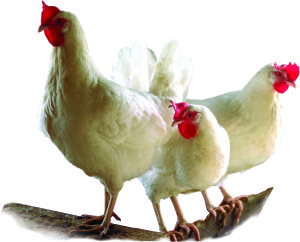
So much time, energy and money goes into raising chickens. Nothing is more satisfying than finding that first perfectly formed egg. Nothing is more devastating than having those eggs taken or the hens harmed.  It is a dangerous world for chickens, and one of the common threats comes in the form of a large rodent with a snake-like tale.  The Rattus norvegicus and Rattus rattus otherwise known as brown and black rats can wriggle their way into the smallest hole and steal away precious eggs and/or maim chickens. What is to be done? Well, as you may have guessed, we have a pee for that – 100% CoyotePee to be exact. But, you don’t have to take my word for it.

“Yes! I told the Chicken Chick about the rats in my coop and she told me to order from you, and so I did!  Thanks, tiff”

So, if you have Templeton the Rat sneaking into your coop, don’t wait. Go to www.predatorpee.com get your CoyotePee right away!

On the home front, I got myself a  hot tub! Once you reach a certain age, you wake with a new and exciting ache or pain every day. Well, I decided to take matters into my own hands, and while the wife was out of town, I looked up ‘hot tub” on that Craigslist thing and voila!  All I can say is aahhhhhhhhh

If you don’t have a hot tub, I hope you are enjoying this late spring evening in some other way.

The PeeMan


Keep Skulking Skunks Away from Backyard Chickens

Hello from the Maine woods! The temperatures has soared today well into the 60’s, and after I finish this post, I may have to hit the back roads on my motorcycle. I may or may not wear my helmet – just don’t tell my daughters.

Well, according to my reading, the black and white fluffy creature that lurks near trash cans and under porches in the wee hours of the morning can also be a vicious threat to poultry. The Mephitis mephitis or common striped skunk will devour eggs and occasionally kill young poultry, and its relative the spotted skunk can be even more of a threat due to its ability to climb. I don’t know about you, but each and every egg Brown Betty lays is precious to me, so the thought of some egg-sucking predator getting to them makes me mad.

Lucky for Betty, and for you, the skunk relies heavily on its sense of smell because it has poor eyesight. This makes it an ideal pest to control by use of the predator-prey instinct that 100%PredatorPee takes advantage of.  FoxPee is what we recommend for use against those monochromatic weasels of the night.  But, you know, as I always say, don’t take my word for it . . .

“I live in San Diego, Cal. and we have so many skunks this year. I’ve called all over town asking how to get rid of them. Everyone said to get a trap and take them to the country to release them. I’m in my 70’s and am not about to trap a skunk! My son in Seattle, Wash. sent me some Fox urine. He said everyone up there uses it but down here they laughed at me. However, it has worked for 3 weeks, but now they’re back. Help! How can I order more ?”
E. Hanley
San Diego, California

Hope the sun is shining where you are, and prayers for those in and around Boston.  The PeeMan

Coyotes Creeping near the Coop? 100% Wolf Urine is the Solution!

Hello! Can you believe that it SNOWED here yesterday. Ridiculous even for Maine! Anyway, while trying to conserve warmth, I stumbled across an informative article about the coyote as a  threat to chickens.  The below text is from http://www.backyardchickens.com/a/coyote-chicken-predators-how-to-protect-your-chickens-from-coyotes.  (For full disclosure – this is information obtained from Backyardchickens.com. They have not in any way endorsed PredatorPee.)

COYOTE (Canis latrans)

General Information

Coyotes are most active at night and during the early morning and late evening hours. In areas where they are not disturbed by human activities, and during the cooler times of the year, they may be active throughout the day. Urban coyotes are becoming very tolerant of human activities. Young coyotes tend to be more active during daylight hours than adults.

 Description

Coyotes are medium sized animals belonging to the dog family. Most adults weigh between 22 to 25 pounds on the average, with males being the larger sex. With large erect ears, slender muzzle, and bushy tail they resemble a small collie dog. In the hotter drier regions , coyotes are tan-brown in color with streaks of gray. In the more mountainous or humid areas, the color is darker with less brown. In the winter the coats become quite dense, especially in the colder areas. The voice of the coyote is quite distinctive, consisting of various howls, high-pitched yaps, and occasional dog like barks.


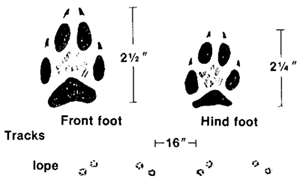
coyotetracks.gif

Range
The coyote is found throughout North America from eastern Alaska to New England and south through Mexico to Panama. It originally ranged primarily in the northwest corner of the US, but it has adapted readily to the changes caused by human occupation and, in the past 200 years, has been steadily extending its range. Sightings now commonly occur in Florida, New England and eastern Canada.

 Methods of Kill

Poultry, such as chickens, ducks, geese and turkeys, are easy prey, and any passing coyote bold enough to approach an area where they are ranging will help itself. Removing problem coyotes will only make space for other coyotes to move into the area. . . Coyotes are tenacious and opportunistic predators that can easily wreak havoc on your poultry farm. These nocturnal hunters will hunt for food whenever they are hungry or if the opportunity presents itself. A chicken buffet that is laid out for their easy access and convenience will attract not just a lone killer, but a pack of merciless coyotes.


Well, just reading about this gives me the chills. I knew coyotes were a threat to dogs and other small animals, but I just hadn’t considered the threat to chickens.  That only  make me want to let more people know about our 100% WolfPee as a deterrent to coyotes. http://www.predatorpee4chickencoops.com/ Check it out.

Thanks,

The PeeMan

Fox in the hen house? We’ve got a pee for that!

Clipart-Fox-Drawing_01

Greetings from the north country!

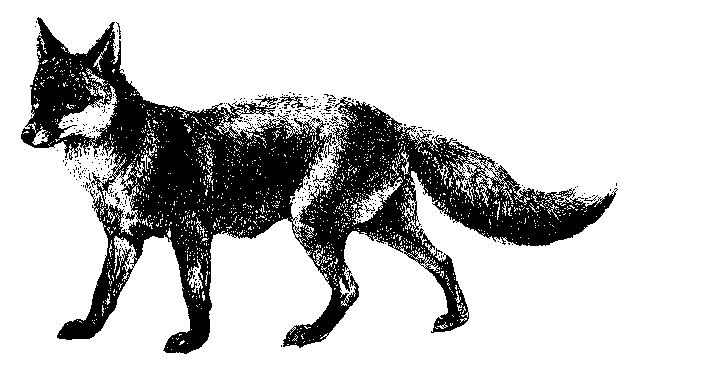
If you raise chickens, I don’t have to tell you how damaging having a fox nearby can be. A single fox can take multiple chickens if allowed.  Not only that, just having a fox nearby can mess with egg production. “. . . the mere presence of a predator lurking around your run area can stress the hens to the point that they stop laying. . . Other larger predators, such as foxes, opossums and skunks, will try and enter your coop as well if you don’t have it securely locked at night.”  (20 Possible Causes for a Decrease in Egg Production by Lisa Steele)

The answer to this threat is 100% pure Wolf urine liquid and granules from Predator Pee. Nothing is more feared in the wild than the wolf.  When you must repel predators like coyotes or foxes, only Wolf Urine will stop them in their tracks. When they think a wolf is around, coyotes, cats, foxes, elk, beavers, bear, mule deer, moose and other larger animals will want to go away quickly. Don’t wait! Protect your chickens! Don’t accept a substitute for 100% Predator Pee.

On a more personal note, I have purchased new foam mattresses for the Airstream, and I will be working with my daughter to reupholster them soon. The interior walls are also almost ready for painting. Gotta get this thing ready so the wife and I can go camping this summer in the beautiful Maine wilderness with the grandkids.  Airstream pictures will be up soon once I figure out how to get them out of my confounded email. An old dog, ya know. Have a good one! Send some warmth up my way.

The PeeMan

Protect Your Backyard Chickens with PredatorPee

The PeeMan's very own Brown Betty

The PeeMan’s very own Brown Betty

Well, isn’t she a beauty? She lays a mean egg, too. This whole backyard chicken thing is a relatively new experiment for the PeeMan. But, a whole host of critters, including foxescoyotesraccoonshawks, and even dogs have been causing problems around chicken coops for decades.  Whether it is in your back yard or a full farming operation, the need for an all-natural repellent to protect your chickens and their precious eggs has never been greater.  As many of you sadly know from first-hand experience, foxes, coyotes, raccoons, hawks, and yes, even dogs eat chickens and ruin your prospects for eggs, whether you plan to eat ’em, sell ’em, or hatch ’em.

Wolf urine is an effective fox and coyote deterrent that repels foxes and coyotes from your chicken coop by creating the illusion that a wolf is nearby. Wolf Urine or Coyote urine will take care of raccoons, our PeeCoy Combo is great for birds, and Bear Urin or Skunk’Umcan keep the dogs away.  Now you can protect your chickens and their eggs with Wolf Pee, Coyote Pee, Bear Pee, and Skunk’Um from PredatorPee.com, the best and most reliable source for predator urines since 1986.

Create a “pee-rimeter” around your chicken coop by using WolfPee liquid with ScentTags, 33 Day Dispensers or ScentWraps.  This will keep fox and coyote away from your chicken coop for good.  This is not a chemical repellent, nor are there any additives whatsoever.  Wolf Urine is completely natural, organic, and 100% real urine!  The one thing that a fox or a coyote fears is a wolf, and wolf urine sends a clear message that a wolf is nearby.  Except no substitute.

Well, that is all for now. The sun shone briefly here for a while today and the temperatures actually rose above 50! Brown Betty was enjoying the sun, too!  I’ve got some pictures of the Airstream project, and I will post them soon. The PeeMan

Beaver Bedlam? We’ve Got A Pee for that.

Greetings from the frozen north woods! Came across some interesting research while I was warming myself by the wood stove.  In this study, wolf urine showed itself to be an effective way to deter beavers. Don’t take my word for it – read their conclusions for yourself.(Italics mine)

Predator cues reduce American beaver use of foraging trails

WILLIAM J. SEVERUD, Northern Michigan University, Department of Biology, 1401 Presque Isle
Avenue, Marquette, MI 49855, USA wseverud@nmu.edu
JERROLD L. BELANT, Carnivore Ecology Laboratory, Forest and Wildlife Research Center, Mississippi
State University, Box 9690, Mississippi State, MS 39762, USA
JOHN G. BRUGGINK, Northern Michigan University, Department of Biology, 1401 Presque Isle
Avenue, Marquette, MI 49855, USA
STEVE K. WINDELS, 360 Highway 11 East, International Falls, MN 56649, USA

Discussion

We found a 95% reduction in beaver numbers at camera stations containing predator urine, indicating that beavers altered their space use in response to an indirect cue of predation risk. Beavers also spent 95% less time at urine-treated camera stations and exhibited no decrease in time spent at control camera stations. Decreased time spent at urine-treated camera stations suggests that antipredator behavior in beavers in our study area was strong, consistent with the risk allocation hypothesis (Lima and Bednekoff 1999). Decreased use and time spent at urine treated camera stations suggests that wolf urine is an effective deterrent to beaver activity and that beavers use olfaction to assess predation risk. In our study area, wolves have large territories and range extensively (Mech 1974); hence, beavers may experience only occasional temporal pulses of risk from wolves. These pulses of risk may be perceived by beavers regardless of actual predation events, which may be affected by available alternate wolf prey (Voigt et al. 1976). Although our study was short in duration, it represented a brief pulse of elevated predation risk. That beavers avoided camera stations containing wolf urine supports the tenet of the risk allocation hypothesis, which states that brief, infrequent pulses of high risk will elicit strong antipredator behaviors in prey species (Lima and Bednekoff 1999). Our data suggest that beavers either reduced total foraging activity or began using unmonitored or untreated trails. American and Eurasian beavers both have exhibited use of olfaction to assess risk by repressing scent-marking behavior (Rosell and Sanda 2006) and foraging (Engelhart and Müller-Schwarze 1995, Rosell and Czech 2000) in response to predator odors.

Well, I’d better go put another log on the fire. Have a good one! The PeeMan

The PeeMan is back and the Rodents are Scared Pee-less

It has been a long absence from the blogosphere for the PeeMan. I have been kind of busy chasing all those animals around to collect the pee. Never fear, for although we have been away from blogging, Predatorpee has been continuing to furnish customers all over the globe with the the best and original 100% Predator Urine. But, you don’t have to take only my word that this stuff works. Take a look at what the expersts have to say:


Chemical in Predator Pee Scares the Pee Out of Rodents

By Joseph Castro | June 23, 2011 10:54 pm

What’s the News: In the animal kingdom, prey species must follow one rule above all others: keep away from predators. To do this, some animals take chemical cues from the urine they stumble upon. Now, new researchpublished in the Proceedings of the National Academy of Science has identified a single molecule in the urine of many mammalian carnivores that causes rodents to scurry in fear. This chemical could eventually help scientists understand instinctual behavior in animals.

How the Heck:

  • A research team at the Harvard Medical School analyzed a group ofolfactory receptors called trace amine-associated receptors (TAARs). They concentrated on one in particular, TAAR4, which is strongly activated by bobcat urine (sometimes used by gardeners to repel small pests). They found that one specific molecule, called 2-phenylethylamine, is responsible for the TAAR4 reaction.
  • To see if 2-phenylethylamine is bobcat specific, the team tested urine samples from 38 mammalian species, including servals, snow leopards, giraffes, zebras, and rodents. They found that the carnivores had the highest concentrations of the molecule, with some species, like lions and tigers, producing up to 3,000 times more 2-phenylethylamine than the herbivores.
  • As a way of checking the role of the molecule, the researchers placed a few drops of lion urine loaded with 2-phenylethylamine in a cage with mice and rats. The rodents avoided that area of the cage. The team then used urine free of the chemical, and found that the rodents had no aversion to it.

What’s the Context:

  • Scientists have long known that chemical cues can mediate predator-prey interactions, and not just in mammalian species. For example, some salamanders and tree frogs use these cues to detect predatory fish.
  • Sometimes these the cues aren’t enough. The parasitic diseasetaxoplasmosis can overcome rodents’ instinctual aversion to predatory urine. In some cases, the disease causes mice to actually seek out areas marked by cat urine. The mechanism is still a bit unclear, but scientists believe that taxoplasma does this by affecting dopamine levels in theamygdala.
  • The exact role of TAARs, first discovered 2001, is also unclear. But, “here we have the first convincing evidence that they might control instinctive behaviour,” Anna Menini, president-elect of the European Chemoreception Research Organization in Paris, told Nature.

The Future Holds:

  • The researchers are working to experimentally show that TAAR4 controls the rodents’ instinctive behavior. They are also trying to pinpoint brain circuits that TAAR4 activates as it responds to 2-phenylethylamine.
  • Future research needs to explain why carnivores have a higher concentration of the 2-phenylethylamine in their urine. The team suspects that it’s a by-product of meat digestion.

How to Keep Coyotes Out of Your Yard

Thousands of coyotes now roam suburban and urban yards and neighborhoods across America. News reports about coyote attacks on pets and other small animals are becoming more common. People are struggling to find ways of keeping them away. One completely natural, yet innovative solution is the use of wolf urine to repel coyotes.  According to the Wikipedia article Coyote: Interspecific predatory relationships, wolves are one of the few natural predators of coyotes and can compete for hunting habitat.

“The gray wolf is a significant predator of coyotes wherever their ranges overlap. Since the Yellowstone Gray Wolf Reintroduction in 1995 and 1996, the local coyote population went through a dramatic restructuring. Until the wolves returned, Yellowstone National Park had one of the densest and most stable coyote populations in America due to a lack of human impacts. Two years after the wolf reintroductions, the pre-wolf population of coyotes had been reduced 50% through both competitive exclusion and predation. In Grand Teton, coyote densities were 33% lower than normal in the areas where they coexisted with wolves, and 39% lower in the areas of Yellowstone where wolves were reintroduced.”

When coyotes believe wolves are in an area, they will move to a less hazardous habitat. By applying wolf urine around the perimeter of a yard, the homeowner can create the impression that wolves are nearby. The scent of urine is one of the primary ways an animal is warned of the presence of a predator and the smell of the wolf urine tells coyotes that this area could be a dangerous place. The coyote’s instincts kick in and they move to a new territory. In addition an added advantage to using wolf urine is that it is completely natural and safe to use around pets.

Until I find more words. . .The PeeMan